
Table of Contents
- How does a quantity differ from a place?
- Where should the line start?
- How do you show first and last?
- What happens when the starting end changes?
- How do you use the sheets and separate answers?
- What if your child starts at the other end?
- Which variation fits your child’s current confidence?
- How can screens and workbooks support the activity?
- Frequently asked questions
The first object is at the agreed start of the line, and the last is at the other end. Show the start before naming a place. Counting the whole group answers a different question: how many there are. A rank describes the place of one object.
How does a quantity differ from a place?
A quantity describes the whole group; a position identifies one item within an agreed order. Ask “How many cards?” and then “Which card is first?” Keep the same materials so that the question changes without introducing a new rule at the same time.
The French ministry’s 2025 mathematics guide distinguishes these uses of number. At home, explore them with large cards without turning the game into a school test. Our guide to counting each object once focuses on quantity; this activity adds the question of position.
Where should the line start?
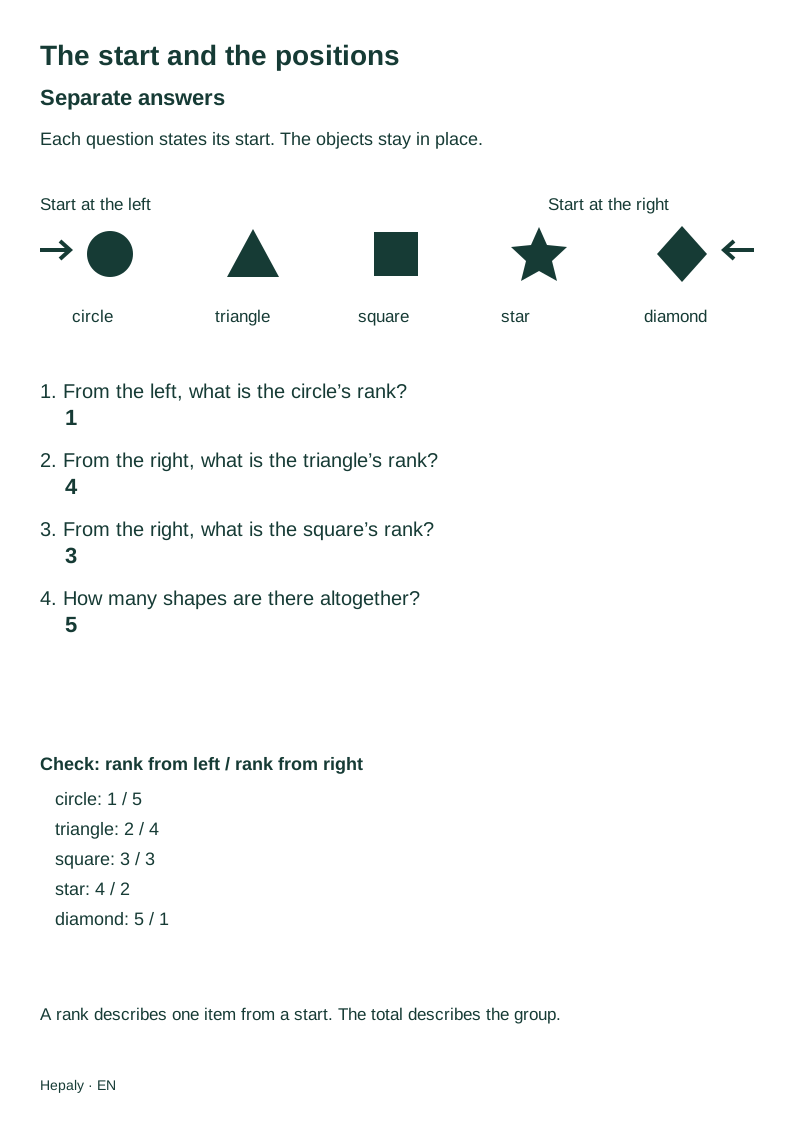
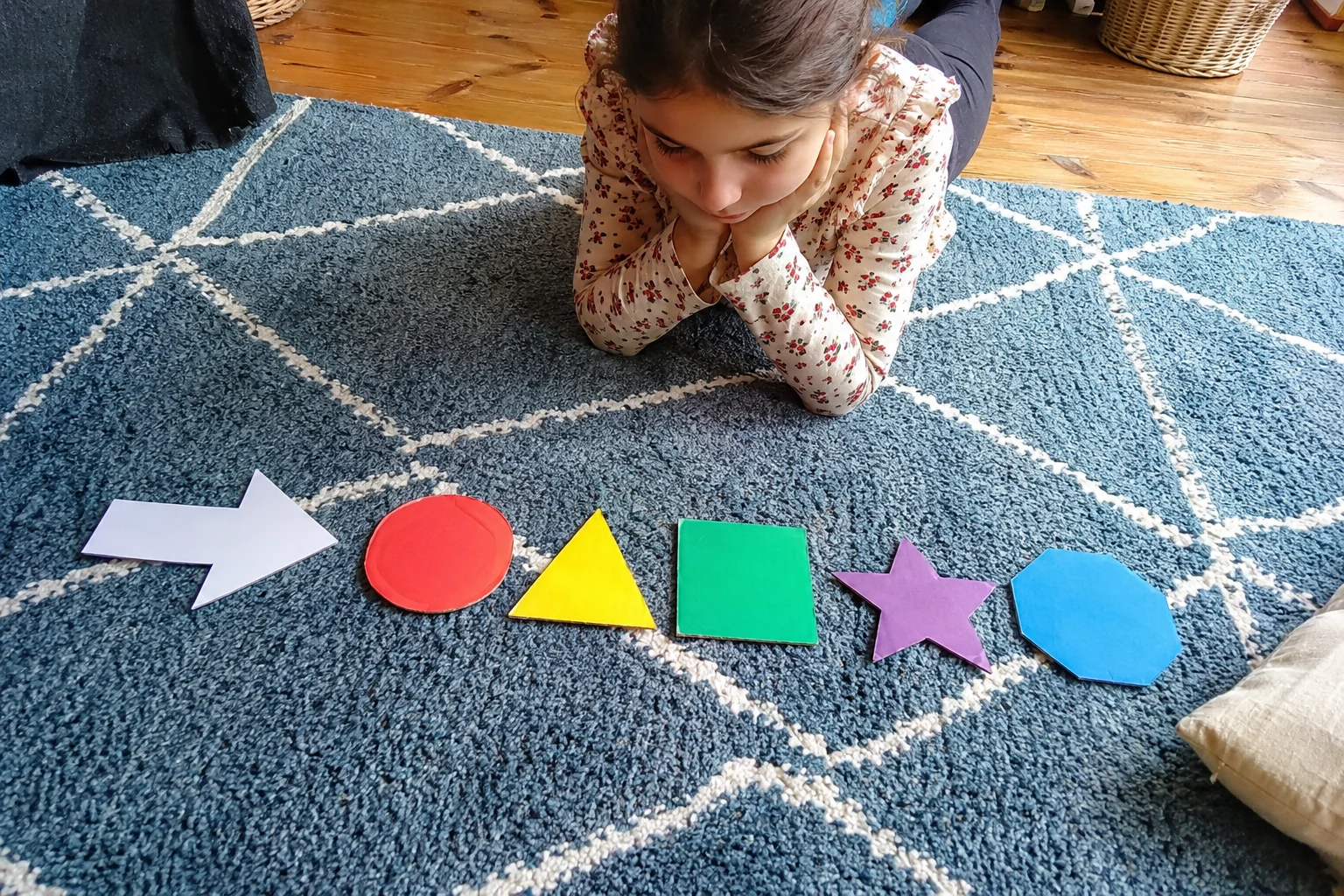
Choose one end and mark it with a paper arrow or a starting card. Show that marker before asking about a position. Two people can point to different items while saying “second” if they start at opposite ends. The instruction needs to identify the start.
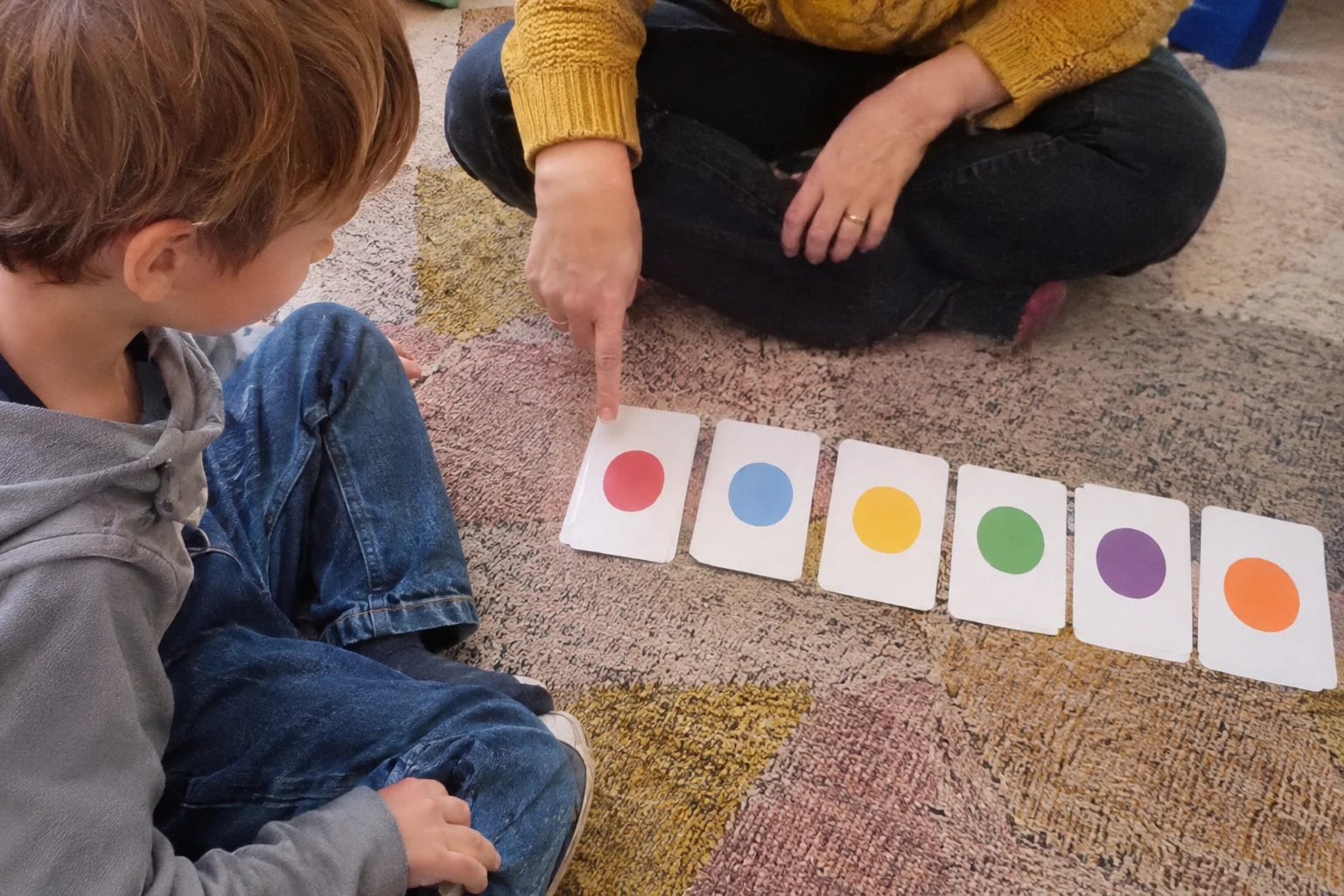
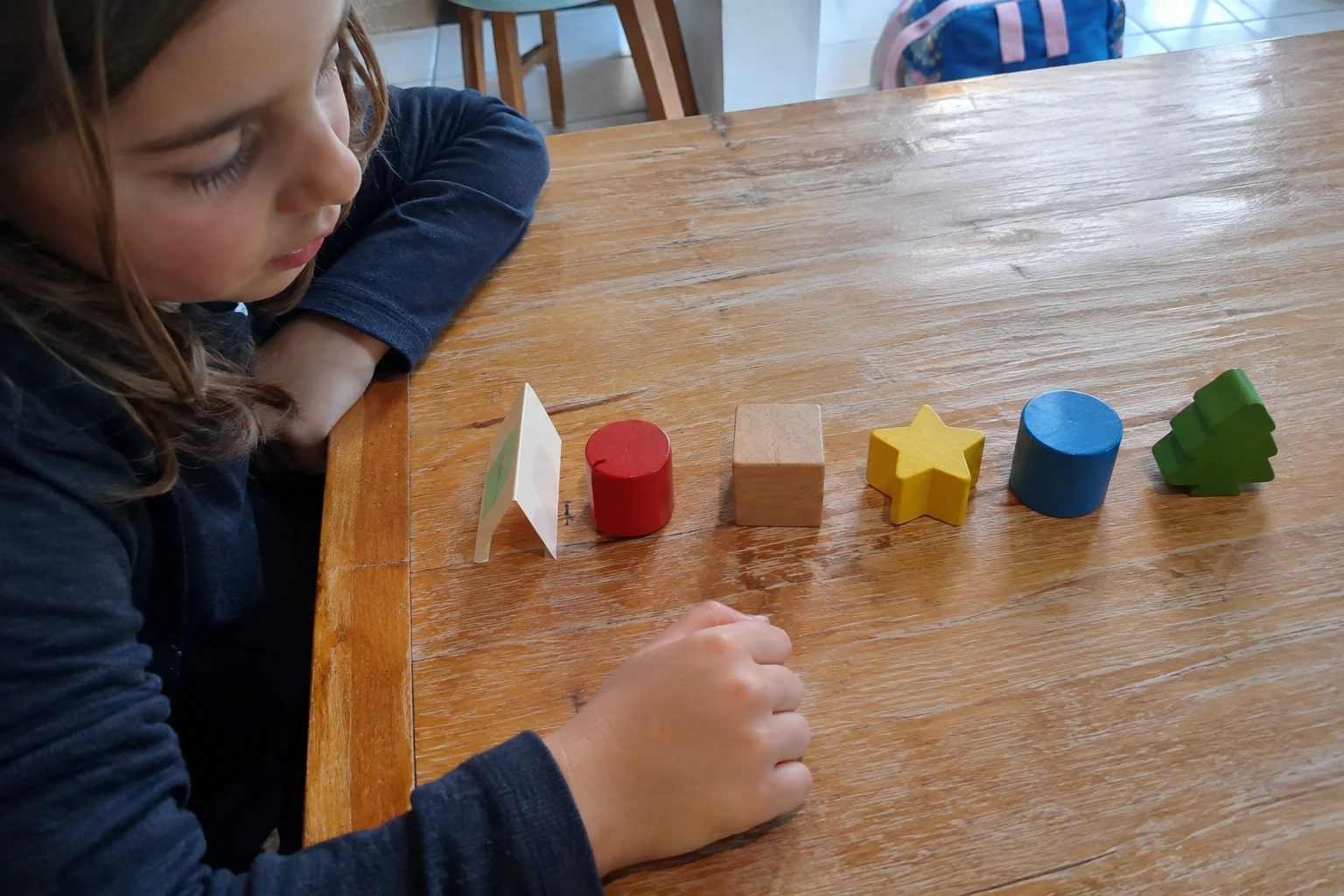
Set the cards out without overlap. Shapes and their names distinguish the items without relying on color. The photographs show possible materials; only the activity drawings and worksheets define the exact objects in our examples. Use large pieces suitable for your child and supervise their handling.
| Shape | Rank from left | Rank from right | Total |
|---|---|---|---|
| circle | 1 | 5 | 5 |
| triangle | 2 | 4 | 5 |
| square | 3 | 3 | 5 |
| star | 4 | 2 | 5 |
| diamond | 5 | 1 | 5 |
How do you show first and last?
Start at the marker and follow the line one object at a time. You meet the first item at the start and the last at the opposite end. Your child can point before naming. Put that gesture into words without also requiring written ordinal words or abbreviations.
In the position reader, choose a shape and a starting end, then check. Changing either choice clears the previous answer because it no longer describes the current instruction. Without a screen, use your own cards and check by following the agreed path.
Read a place from the chosen start
Choose the shape and the start. Changing a choice clears the previous answer.
Choose, then check the position.
Rank: {r}. Total shapes: {n}.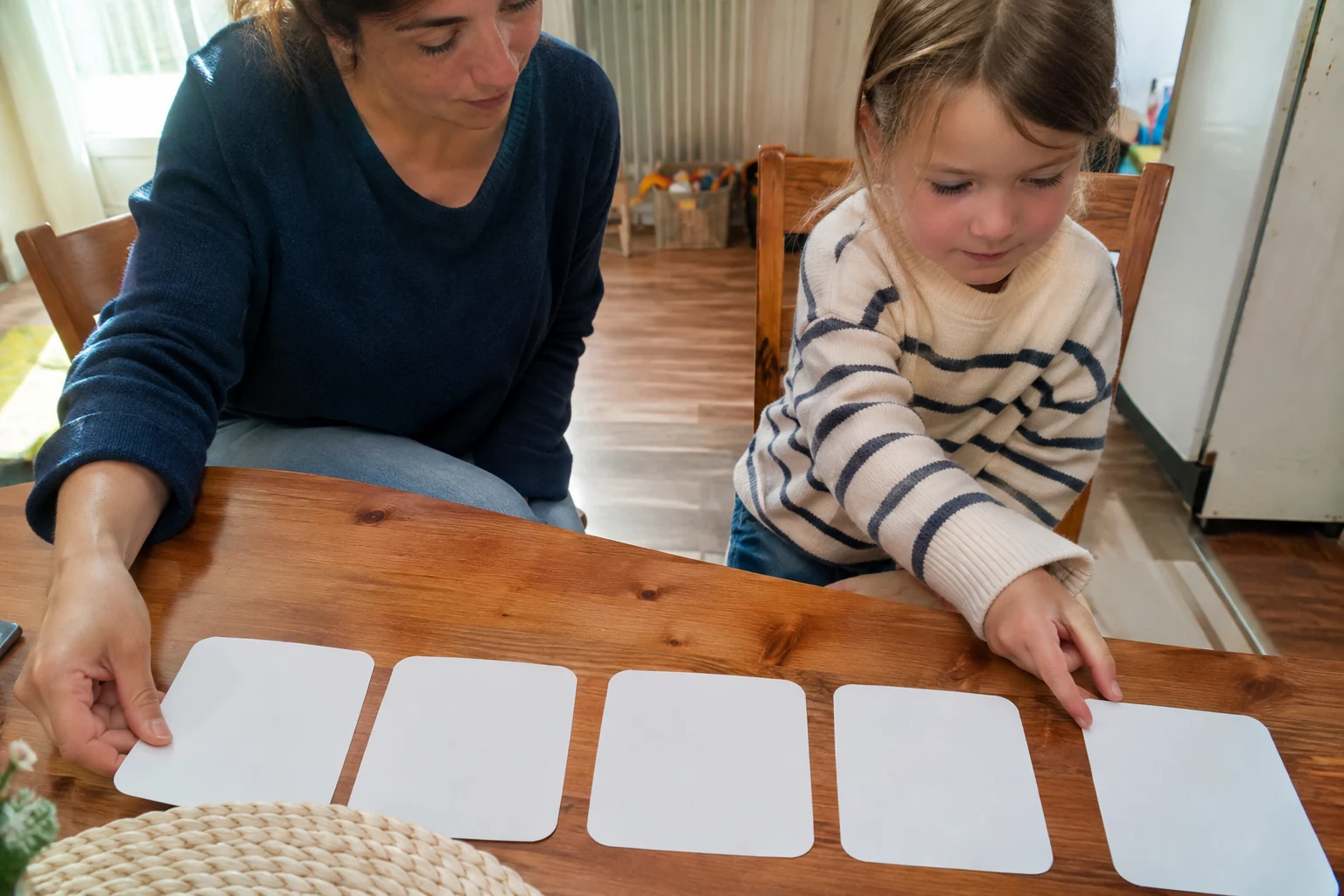
What happens when the starting end changes?
You can change the starting end without moving the objects. Follow the line again from the new marker. The total stays the same because nothing was added or removed. An item’s named position can change, but it does not have to change for every item.
Our five-shape line has a middle item. Use the table to check its position from either end rather than claiming that every rank changes in the same way. The French ministry’s April 2023 resource includes changing origin and direction. Here, change only one setting at a time and keep the evidence visible.
Three instructions with visible evidence
Your answer matches the stated start.Return to the stated start and follow the shapes.How do you use the sheets and separate answers?
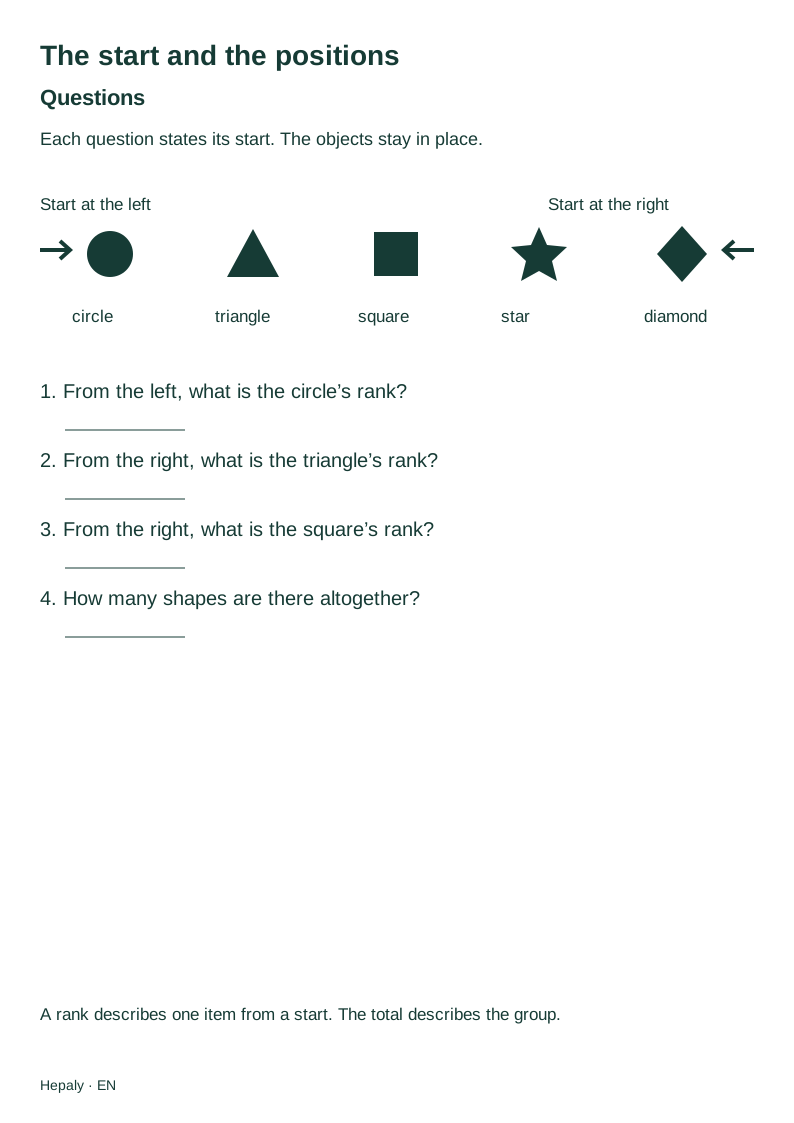
The question sheet shows the starting marker and the shapes to inspect. Keep the answer sheet separate while exploring, then compare the two sheets. Both documents show the same symbols. An answer does not depend on a missing drawing or on having a color printer.
Open the version in your language and check print preview. An adult can read each question while the child points to an answer. For another paper activity, explore the free activity tools. This worksheet asks for no name, account or submitted answer.
Open the separate answer sheet
What if your child starts at the other end?
Return to the stated starting marker first. Ask “Where did you start?” before correcting the shape your child points to. That helps distinguish a different starting point, a skipped item and an unfamiliar word. These observations concern this attempt, not a diagnosis or an overall measure of ability.
Bring the cards closer if pointing is difficult, without overlap or silently changing their order. Shorten the line, demonstrate once or return later. The checklist only helps prepare the materials; its counter does not score the child’s performance.
Prepare a clear line
Checked items: 0 of 5.
Checked items: {n} of 5.Which variation fits your child’s current confidence?
Begin with a short line and a fixed start when the marker is new. For a child who is comfortable, keep the line and change only the start, or ask the child to give an adult an instruction. The 4–6 and 7–10 age bands describe possible variations, not required achievements at an age.
The make-ten activity asks about parts of a total. Repeating patterns ask you to follow a repeated rule. All three games can use cards, but state the chosen question before starting. A different instruction is not automatically a harder one.
How can screens and workbooks support the activity?
The English video demonstrates pointing to objects one at a time when counting. It supports the quantity part of our distinction, rather than serving as an answer key for ordinal positions. Watching is optional; return to your own cards to identify the start and name a place.
Hepaly workbooks offer other downloadable, printable PDF activities. All six commercial workbooks and previews are in French, including when this guide is read in English or Spanish. Choose according to your child’s needs; a result in this activity does not determine which workbook to buy.
Frequently asked questions
Can you say first without showing the start?
Everyone playing needs to know the start. A visible marker prevents the same instruction from suggesting two different paths.
Does third mean three objects?
Third names a place from a starting point. Three objects describes a quantity. Show what the question asks you to identify.
Does changing ends always change an item’s rank?
The middle item in an odd-length line can keep its rank from either end. Check the example instead of claiming that every position changes.
Does a child need to write 1st and 2nd?
A child can start by pointing and speaking. Writing adds another task that can wait for a different session.
Can you use this without JavaScript?
The table, worksheets, answers and instructions remain available. Use real cards and follow the chosen starting marker.
Does the checklist counter give a score?
It counts checked preparation items. It does not measure school level, progress or the child’s overall ability.