
Table of Contents
For drawing dictation, an adult describes one short action and the child draws it before hearing the next. Choose familiar shapes and name the spatial reference: the paper, the frame, or another shape. Compare choices afterward without grading artistic quality or treating this game as a spelling test.
What should you prepare and which words should you check?
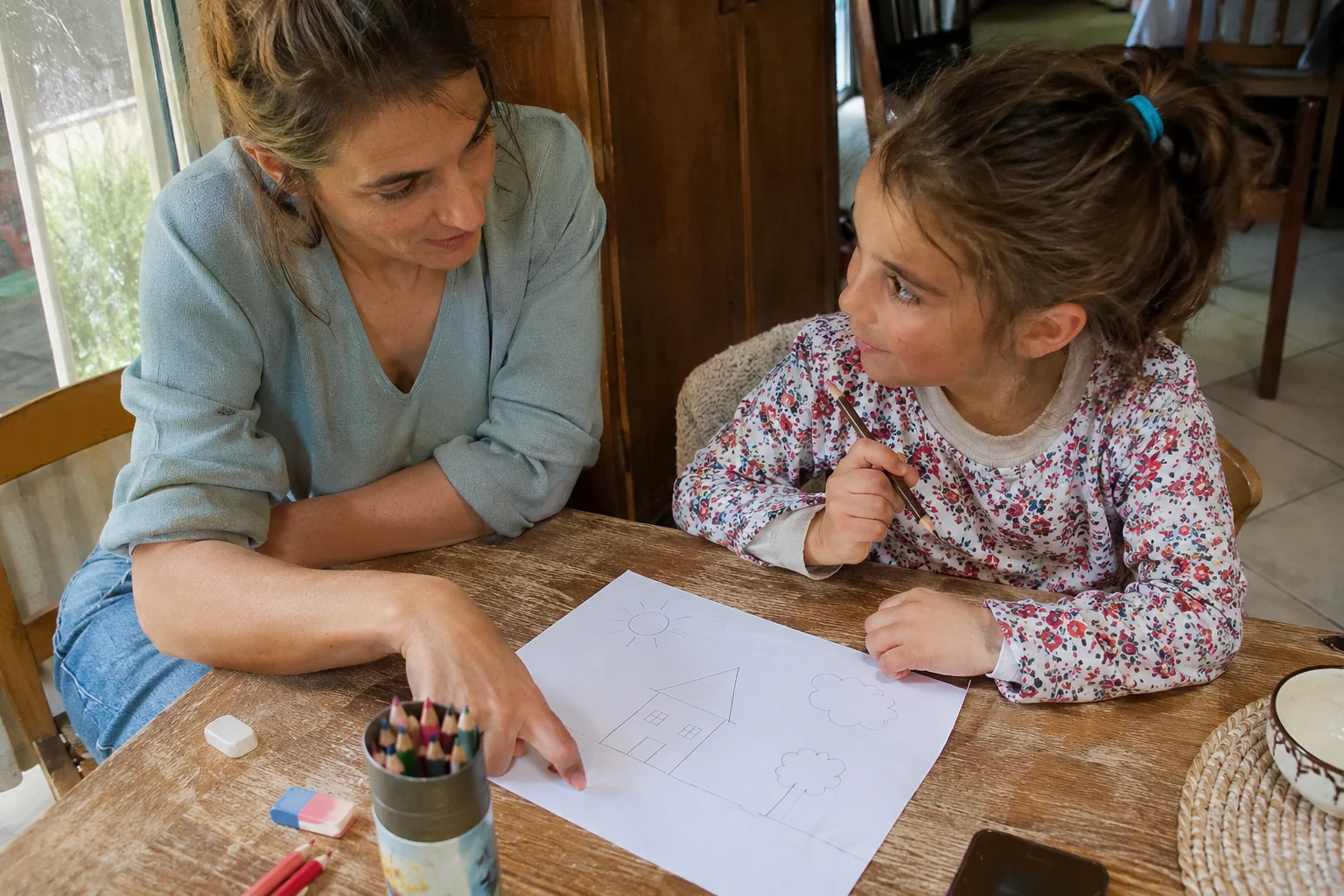
Paper, a suitable pencil, and a stable space are enough. An adult prepares an empty frame and a visible mark at the top of the page. Sit on the same side so you share the same orientation. Keep the paper upright throughout the game. Printing is optional: a hand-drawn frame works.
Show the shapes and useful words before playing. “Circle,” “line,” “inside,” and “below” may not mean the same thing to everyone yet. Ask your child to point to the reference instead of assuming the vocabulary is familiar. Activities for building vocabulary offer other opportunities to make words precise.
| Approximate age | Suggestion | Possible support |
|---|---|---|
| 4–6 years | One simple relationship | Point to the reference |
| 7–10 years | Several separate instructions | Reword, then swap roles |
How do you give one instruction at a time?
Announce one action and let your child say when they are ready for the next. Start with “Draw a circle in the middle of the frame,” then “Add a dot inside the circle.” Repeat the same sentence when asked. Speed is not our aim: the pace depends on your child and the support they want.
Do not silently add a condition after the drawing. If you wanted a small circle, “small” needed to be in the instruction. A different interpretation is an opportunity to review the wording together. The three cards below prepare that language rather than ranking children by attention.
Three references for play
Choose a reference
Keep a shared top of page and name the reference shape.
Give one action
Let your child request repetition before continuing.
Compare the relationship
A dot inside the circle respects a relationship; outlines may vary.
A first set of four instructions
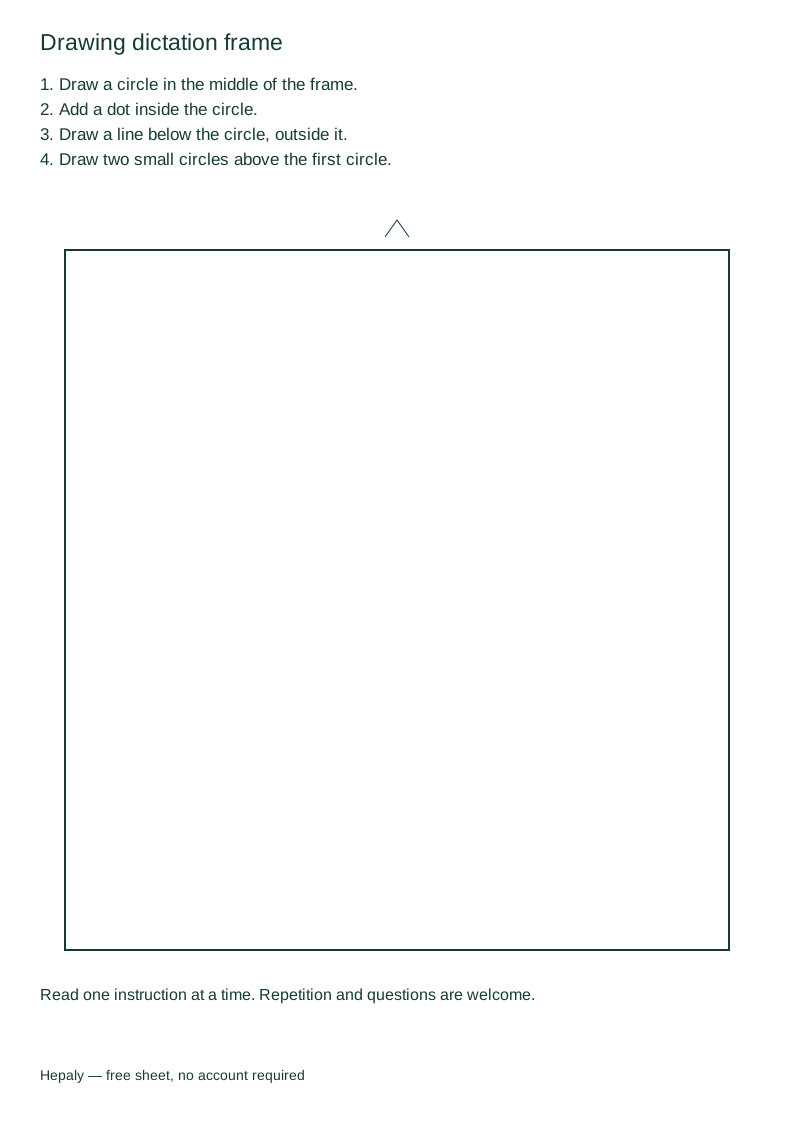
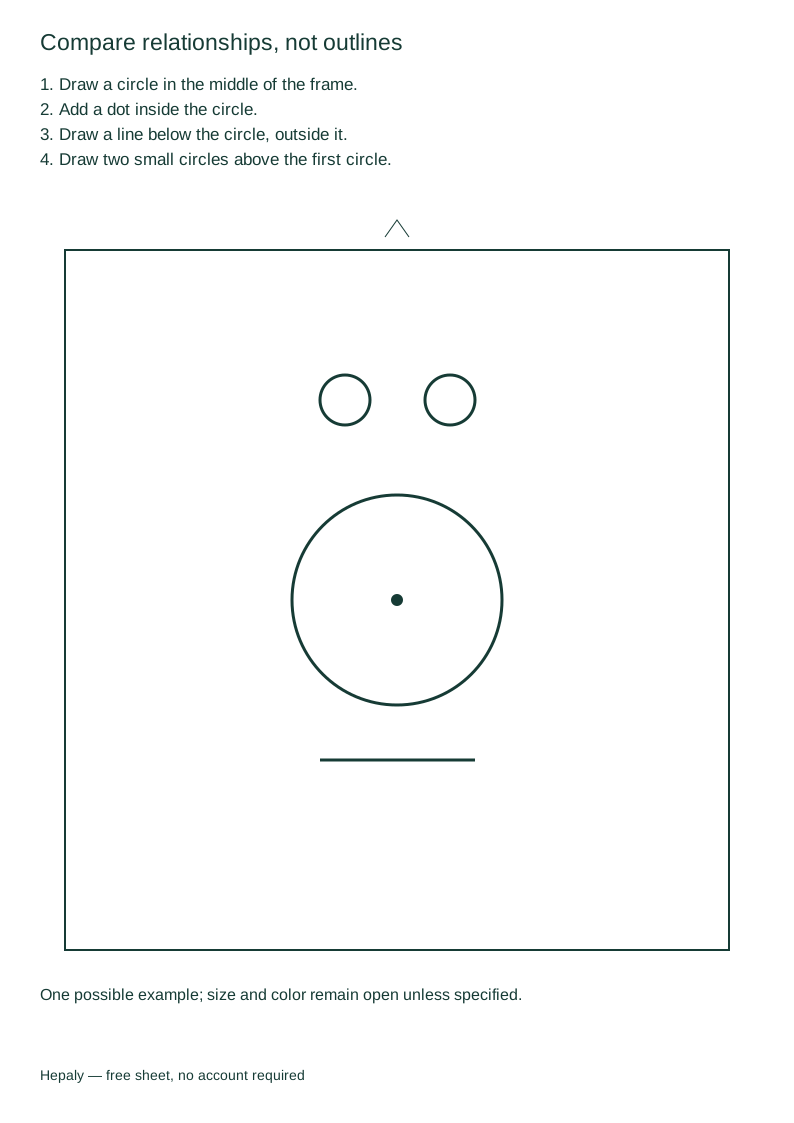
Our sheet asks for a circle in the frame’s middle, a dot inside it, a line below the circle, and two small circles above it. Read each action separately. Here “below” and “above” refer to the first circle rather than the paper’s edge. The dot belongs inside; the line stays outside. Size and color remain open unless the instruction specifies them.
The comparison sheet shows one possibility that respects these relationships. It is not a perfect drawing to copy: several versions work. If your child draws something different, ask which sentence they followed before correcting it. The answers concern the requested relationships rather than smooth outlines.
Open the relationship comparison
What if the drawings differ?
Return to the exact sentence and its reference. “Next to” leaves several possibilities; “to the right of the circle” leaves fewer, provided you share an orientation. A first session can stay with inside/outside and above/below without introducing left/right. The guide to using a simple map also distinguishes a drawing from the place it represents.
Do not infer a general attention or language difficulty from one result. An unfamiliar word, turned paper, or ambiguous instruction can change the drawing. Try rewording and ask what helps. If your child wants to stop, keep the drawing as a record of the trial rather than demanding repetitions until it matches.
Check the instruction
Must we draw quickly?
No. Keep a pace that allows understanding and questions.
Can different drawings both work?
Yes, when each respects the requested relationships.
Is “above” always enough?
No. Name the element it refers to.
Swap roles and continue without scores
Your child can describe while you draw. Follow what is said, then look together for useful details. This role change leaves room for questions without making every hesitation an error. This is not a spelling dictation: no letters are required here.
You can then invent another relationship, keep the same frame, or move to free drawing. The video presents another drawing or spatial-language activity depending on language; it adds context without replacing our instructions. Hepaly workbooks offer other printable activities; commercial volumes remain in French even though this guide and its free sheets are available in three languages.
Prepare together
No data is stored.
Frequently asked questions
Must my child know how to write?
No. This activity uses shapes and spoken words.
Can I repeat an instruction?
Yes, and allow time for questions.
Should we use a timer?
No. Our version is not based on speed.
Must drawings look identical?
No. Compare the requested relationships, not artistic quality.
What if the paper turns?
Reestablish the top marker before continuing.
Can we play without a printer?
Yes. Draw a frame on ordinary paper.